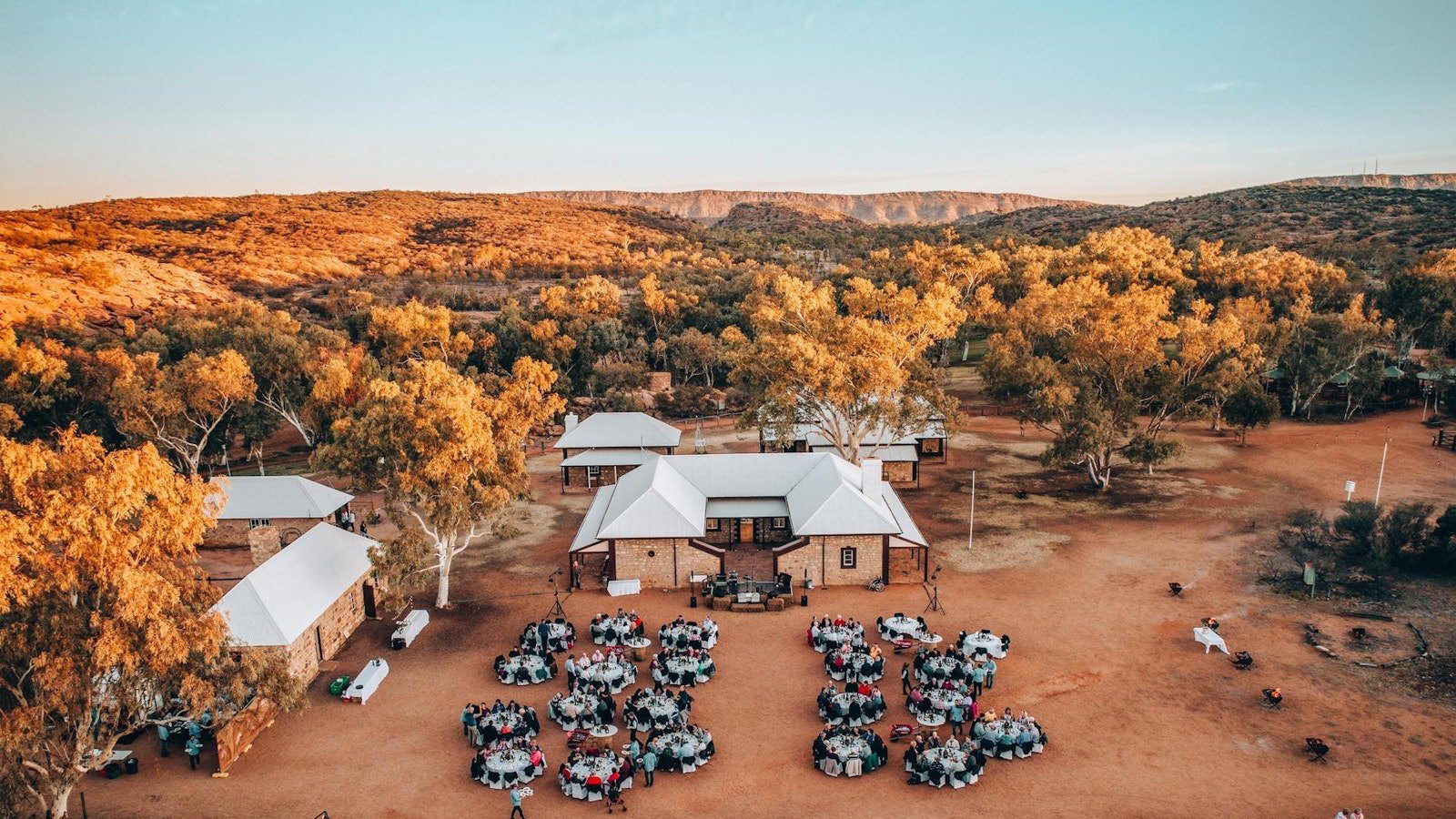
Alice Springs sits almost exactly at the geographic centre of Australia, a lone town ringed by the ochre folds of the MacDonnell Ranges and the vast, silent expanse of the Red Centre desert. Founded around a 19th-century telegraph repeater station, "the Alice" has grown into the cultural and logistical heart of the Outback — a place where Arrernte Aboriginal heritage, pioneering settler history, and modern bush ingenuity (the Royal Flying Doctor Service, the School of the Air) all converge in one compact, walkable town.
For most travellers, Alice Springs is also one of the great romantic rail destinations on earth, because it is the signature stop of The Ghan, the legendary transcontinental train that links Adelaide to Darwin across nearly 3,000 kilometres of desert. Arriving here by rail rather than by road or air is part of the destination's magic — after a day and night crossing red dust plains and saltbush country, stepping off The Ghan into Alice Springs feels like a genuine frontier arrival, exactly as it did for the original narrow-gauge line built in the 1920s.
Beyond the town itself, Alice Springs is the gateway to some of Australia's most storied landscapes, including the East and West MacDonnell Ranges, with their gorges, waterholes and ancient geology stretching back hundreds of millions of years. Whether you're here for a few hours during a Ghan off-train excursion or staying on to explore further, Alice Springs rewards travellers with a rare, immersive sense of the true Outback.
- ✦Geographic heart of Australia's Red Centre
- ✦Signature stop on The Ghan's Adelaide-Darwin route
- ✦MacDonnell Ranges gorges and waterholes
- ✦Rich Arrernte Aboriginal culture and art
- ✦Historic Telegraph Station on the Todd River
- ✦Royal Flying Doctor Service and School of the Air
- ✦Gateway to Uluru and the Outback interior
Places to See in Alice Springs
Alice Springs Desert Park
A beautifully designed 1,300-hectare park where the desert's habitats — sand country, woodland and gorges — are recreated alongside their native wildlife. Highlights include free-flying birds of prey shows, a nocturnal house with bilbies and thorny devils, and excellent Aboriginal interpretation of plant and animal knowledge.
Alice Springs Telegraph Station Historical Reserve
The original settlement from which the town takes its name, this beautifully restored 1870s repeater station sits beside a permanent waterhole on the Todd River. Its stone buildings tell the story of the Overland Telegraph Line that first connected Australia to the world, and of the Arrernte people who called this country home long before.
Anzac Hill
The town's most-visited lookout, reached via the pleasant Lions Walk, offers 360-degree views over Alice Springs to the MacDonnell Ranges beyond. It doubles as a war memorial and is especially striking at sunrise or sunset, when the ranges glow deep red.
Royal Flying Doctor Service Alice Springs Tourist Facility
An engaging museum and working base for the iconic outback medical service, with interactive exhibits, historic aircraft and holographic storytelling explaining how the RFDS has kept remote Australia connected to emergency care since 1928.
Alice Springs School of the Air Visitor Centre
Watch lessons broadcast live to children scattered across a “classroom” of 1.3 million square kilometres — one of the most distinctive expressions of life in the remote Outback, running continuously since 1951.
Araluen Cultural Precinct
A hub of Central Australian Aboriginal art and culture, combining galleries, a museum and performance spaces, showcasing renowned Aboriginal watercolourists and contemporary desert artists.
West MacDonnell (Tjoritja) National Park
Just outside town, this ancient mountain range holds a string of dramatic gorges and permanent waterholes — Simpsons Gap, Standley Chasm and Ormiston Gorge among them — offering some of the finest bushwalking and scenery in Central Australia.
Alice Springs Reptile Centre
An easy, family-friendly stop in the town centre showcasing the Red Centre's snakes, lizards and the famous perentie monitor, with knowledgeable keeper talks throughout the day.
Food & Gastronomy
Alice Springs' food scene reflects its position as the Outback's unofficial capital: a mix of native "bush tucker" ingredients, hearty pastoral-station cooking, and a surprisingly lively café culture fed by the town's role as a travellers' crossroads.
- Kangaroo and camel — lean, gamey meats that are Central Australian menu staples, often grilled as steaks or skewers and paired with native pepperberry or bush tomato sauces.
- Bush tucker native ingredients — look for dishes featuring quandong (native peach), wattleseed (roasted and ground into a coffee-like flavour used in damper and desserts), and Kakadu plum, one of the world's richest natural sources of vitamin C.
- Damper — the traditional Outback soda bread, still cooked over campfire coals on many station tours and often served warm with golden syrup or bush honey.
- Barramundi — though caught further north, this prized native fish appears on Alice Springs menus alongside other Territory produce.
- Todd Mall Markets — held periodically in the pedestrian heart of town, these markets bring together Aboriginal art stalls, bush food producers and live music, a good way to sample local flavours in one place.
- Coffee and café culture — Alice Springs has a disproportionately good café scene for its size, a legacy of its role as a hub for travellers, grey nomads and outback workers passing through.
Dining out is generally relaxed and unpretentious, with an emphasis on generous portions, local produce and the kind of hearty fare that suits a town built around endurance, distance and the desert climate.