Jaisalmer is the Thar Desert's golden mirage made real: a fortress city of honey-yellow sandstone that seems to grow straight out of the dunes. At its heart stands Jaisalmer Fort, one of the few 'living forts' in the world, its ramparts still enclosing homes, temples, shops and guesthouses much as they have for centuries. Beyond the ramparts, the old town unfurls in a maze of narrow lanes lined with intricately carved havelis, the mansions of merchants who grew rich on the camel caravan trade between India and Central Asia.
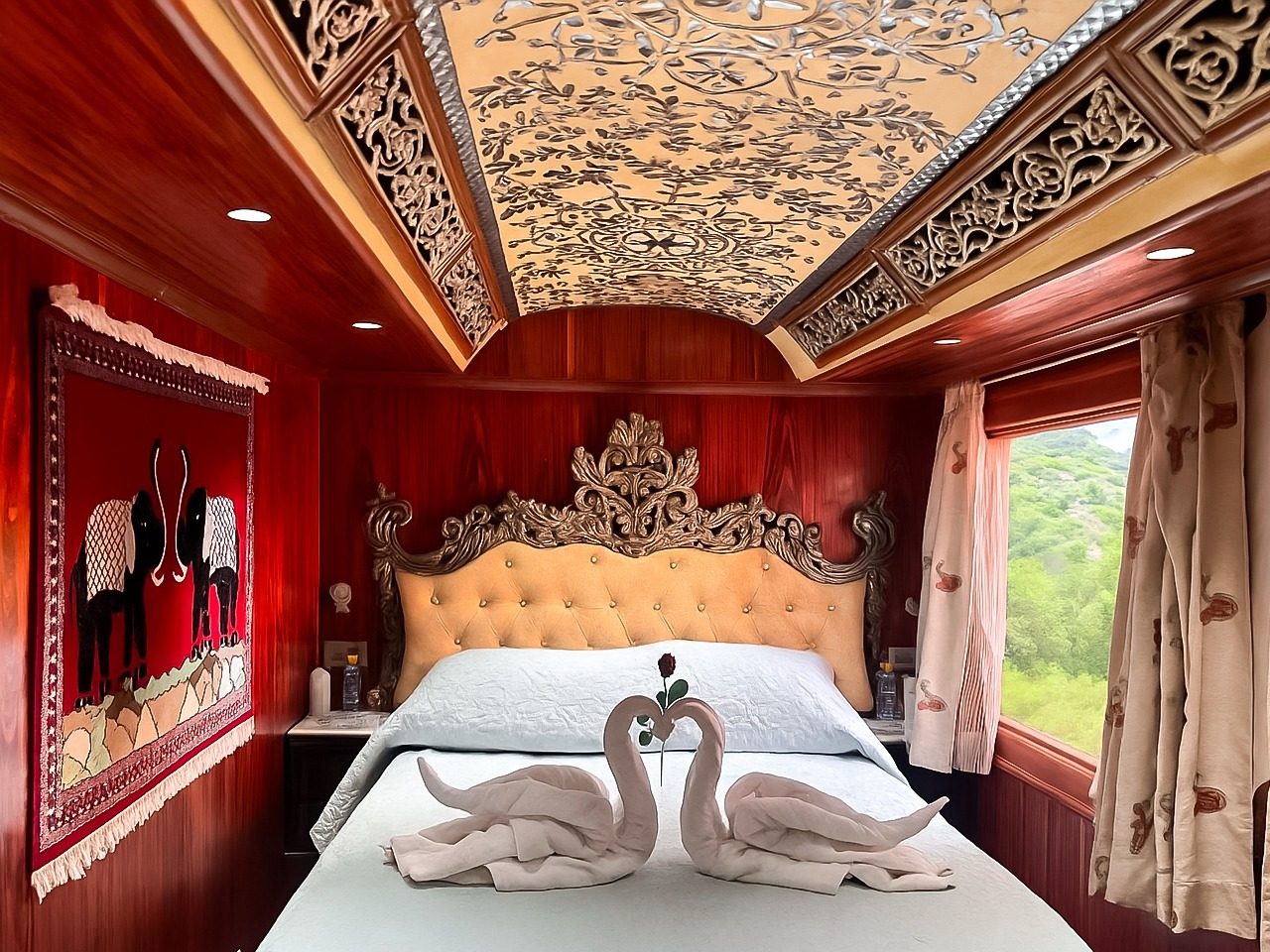
This remote corner of Rajasthan, close to the Pakistan border, is best reached in real comfort aboard the Palace on Wheels, the legendary luxury train that has carried travellers across royal Rajasthan since 1982. Arriving by rail after a day of desert scenery gives Jaisalmer the sense of arrival it deserves — a walled citadel appearing on the horizon like something from a Rajput legend.
Jaisalmer rewards travellers who linger: golden light on carved stone at dawn and dusk, camel safaris into the surrounding dunes, and a pace of life still shaped by desert rhythms. It is one of the most atmospheric stops on any Rajasthan rail journey.
- ✦Living fortress of golden sandstone
- ✦UNESCO-listed Jaisalmer Fort
- ✦Intricately carved merchant havelis
- ✦Camel safaris in the Thar Desert
- ✦Sunset over the Sam sand dunes
- ✦Royal cenotaphs at Bada Bagh
- ✦Aboard the legendary Palace on Wheels
Places to See in Jaisalmer
Jaisalmer Fort (Sonar Quila)
Built in 1156 by Rawal Jaisal, this UNESCO World Heritage Site is one of the very few forts on earth still inhabited, with roughly a quarter of the old city's population living within its walls. Its massive golden ramparts house palaces, temples and havelis reached through a sequence of four fortified gates.
Raj Mahal (Fort Palace)
The former royal residence of the Bhati rulers inside the fort, now a museum displaying royal artefacts, armoury and intricately decorated durbar halls, with views over the city from its rooftop terraces.
Patwon Ki Haveli
The grandest of Jaisalmer's merchant mansions, actually a cluster of five havelis built by a wealthy Jain trader family, famed for gold-leaf ceilings and some of the most elaborate stone lattice-work (jharokhas) in Rajasthan.
Nathmal Ki Haveli and Salim Singh Ki Haveli
Two more of the city's celebrated 19th-century havelis, richly carved by teams of stonemasons working in mirror-image halves; Salim Singh's haveli is notable for its distinctive arched, peacock-topped upper storey.
Jain Temples of the Fort
A cluster of exquisitely carved 12th–15th century Jain temples within the fort walls, dedicated to Rishabhanatha and Parshvanath, renowned for their intricate yellow sandstone sculpture work.
Gadisar Lake
A serene artificial lake built in the 14th century as the city's water reservoir, ringed by small temples, shrines and a monumental carved gateway (Tilon Ki Pol); popular at sunset and for boating.
Thar Desert and Sam Sand Dunes
The rolling dunes of Sam, around 40km from the city, are the classic setting for camel safaris and desert camps, especially magical at sunrise and sunset.
Bada Bagh
A garden complex of royal chhatris (cenotaphs) commemorating generations of Jaisalmer's rulers, set on a hillside overlooking millet fields, particularly photogenic at sunset.
Food & Gastronomy
Jaisalmer's desert cuisine developed out of necessity — scarce water and fresh vegetables led to inventive dishes built on lentils, buttermilk, gram flour and dried ingredients that keep in the desert heat, alongside rich use of ghee and milk from local herds.
- Dal Baati Churma — Rajasthan's signature dish: hard-baked wheat rolls (baati) cracked open and doused in ghee, served with spiced lentils (dal) and a sweet crumbled wheat-and-jaggery churma.
- Ker Sangri — a distinctively desert vegetable dish made from dried ker berries and sangri beans, foraged from local desert shrubs and cooked with tangy spices.
- Gatte ki Sabzi — gram-flour dumplings simmered in a spiced yogurt gravy, a Rajasthani staple born of a region with little fresh produce.
- Kadhi — a tangy buttermilk-and-gram-flour curry, often paired with rice or bajra roti.
- Bajra Roti — flatbread made from pearl millet, the traditional grain of the arid Thar region, usually eaten with ghee and jaggery or spicy chutneys.
- Mirchi Bada and Pyaaz Kachori — popular street snacks found around the fort's bazaars, spiced fried chilies and onion-filled pastries best eaten hot with tamarind chutney.
- Ghotua Laddoo and Kalakand — Jaisalmer's noted sweets, made with ghee, gram flour and milk solids, sold in the old city's traditional sweet shops.
In the evenings, rooftop restaurants around the fort serve thali platters overlooking the illuminated ramparts, while desert camps beyond the Sam dunes lay on traditional Rajasthani dinners under the stars, often with folk music and dance.