
Santiago de Compostela is the spiritual capital of northwestern Spain, a compact granite city in Galicia where medieval pilgrim routes converge on one of Christendom's great cathedrals. For over a thousand years, walkers have arrived here via the Camino de Santiago, but travellers can also reach this UNESCO World Heritage city in far greater comfort aboard a luxury train, arriving well-rested to explore its cobbled lanes, baroque facades, and rain-washed plazas.
Wrapped in the deep green hills of Galicia, Santiago blends monastic quiet with lively student energy, tucked-away taperías, and a market culture built around the Atlantic's bounty. Its Old Town, one of the best-preserved in Europe, rewards slow wandering between grand religious monuments and unassuming stone alleyways scented with octopus stew and warm empanada.
Santiago de Compostela is a signature stop on Palace Trains' Galician rail journeys, visited on both the Costa Verde Express, which threads the Cantabrian and Galician coasts between Bilbao and Santiago, and El Transcantábrico Gran Lujo, the historic luxury train that has long made this pilgrimage city one of its most memorable destinations along Spain's Green Coast.
- ✦Cathedral of Santiago de Compostela and the Pórtico de la Gloria
- ✦UNESCO-listed granite Old Town
- ✦Endpoint of the historic Camino de Santiago
- ✦Pulpo a la gallega and tarta de Santiago
- ✦Mercado de Abastos food market
- ✦Monastery of San Martiño Pinario
- ✦Visited by the Costa Verde Express and El Transcantábrico Gran Lujo
Places to See in Santiago de Compostela
Cathedral of Santiago de Compostela
The city's monumental heart and the traditional endpoint of the Camino de Santiago, built mainly between 1075 and 1211 with later Gothic and Baroque additions. Beneath its high altar lies the crypt said to hold the remains of the Apostle St James, and inside the west entrance is the Pórtico de la Gloria, a Romanesque masterpiece of some 200 carved figures.
Praza do Obradoiro
The grand central square fronting the cathedral, ringed by some of Santiago's finest buildings: the Renaissance Hostal dos Reis Católicos, the neoclassical Pazo de Raxoi, and the Colegio de San Xerome. It is the natural gathering point for pilgrims completing their journey.
Museo das Peregrinacións e de Santiago
A museum dedicated to the history of the pilgrimage itself, tracing the cult of St James, the medieval routes that fed into the city, and the evolution of the cathedral and its surrounding streets.
Monastery of San Martiño Pinario
Just steps from the cathedral, this is the second-largest monastery in Spain, a Baroque complex with an imposing facade, gilded altarpieces, ornately carved choir stalls, and a serene cloister open to visitors.
Mercado de Abastos
Santiago's bustling covered market, where Galician fishmongers and farmers sell the day's catch, cheeses, and produce. It's one of the best places to see (and taste) the raw ingredients behind Galician cuisine, with several market stalls cooking your purchases to order.
Parque da Alameda
A leafy park just west of the Old Town offering some of the best postcard views back toward the cathedral's spires, along with shaded promenades, eucalyptus groves, and a small chapel.
Rúa do Franco and the Old Town lanes
The atmospheric heart of Santiago's historic centre, lined with granite houses, pilgrim taverns, and artisan shops, radiating out from the cathedral in a maze that rewards aimless wandering.
Praza da Quintana
A striking two-tiered square behind the cathedral's Holy Door (Puerta Santa), used historically as a gathering place and known for its dramatic stone staircase and evening ambience.
Food & Gastronomy
Santiago de Compostela sits at the centre of Galicia's seafood-driven, ingredient-first cuisine, shaped by Atlantic waters and lush green countryside. Dining here tends to be unfussy and generous, built around superb raw materials rather than elaborate technique.
- Pulpo a la gallega — Galicia's iconic dish: tender boiled octopus sliced into medallions, dressed with olive oil, coarse salt, and smoked paprika, traditionally served on a wooden plate, best paired with a chilled glass of Ribeiro wine.
- Tarta de Santiago — a dense, moist almond cake dusted with powdered sugar and stencilled with the Cross of St James, Santiago's most famous dessert and a protected regional specialty (IGP).
- Empanada gallega — a savoury, flaky pastry pie filled with tuna, cod, meat, or pork, sold whole or by the slice in bakeries across the Old Town.
- Caldo gallego — a warming broth of white beans, potatoes, grelos (turnip greens), and chorizo or pork, classic cold-weather Galician comfort food.
- Pimientos de Padrón — small green peppers, flash-fried in olive oil and finished with coarse salt; mostly mild, with the occasional fiery surprise.
- Percebes and other shellfish — Galicia's prized goose barnacles alongside mussels, clams, and scallops, all pulled from the cold Atlantic waters along the coast.
- Albariño wine — the crisp, aromatic white wine of neighbouring Rías Baixas, the natural pairing for Santiago's seafood-heavy tables.
For the full experience, browse the stalls of the Mercado de Abastos, then settle into one of the tucked-away tabernas near the cathedral for a plate of octopus and a glass of local wine, a ritual as old as the pilgrimage itself.
Luxury Trains That Visit Santiago de Compostela
 Europe · Spain
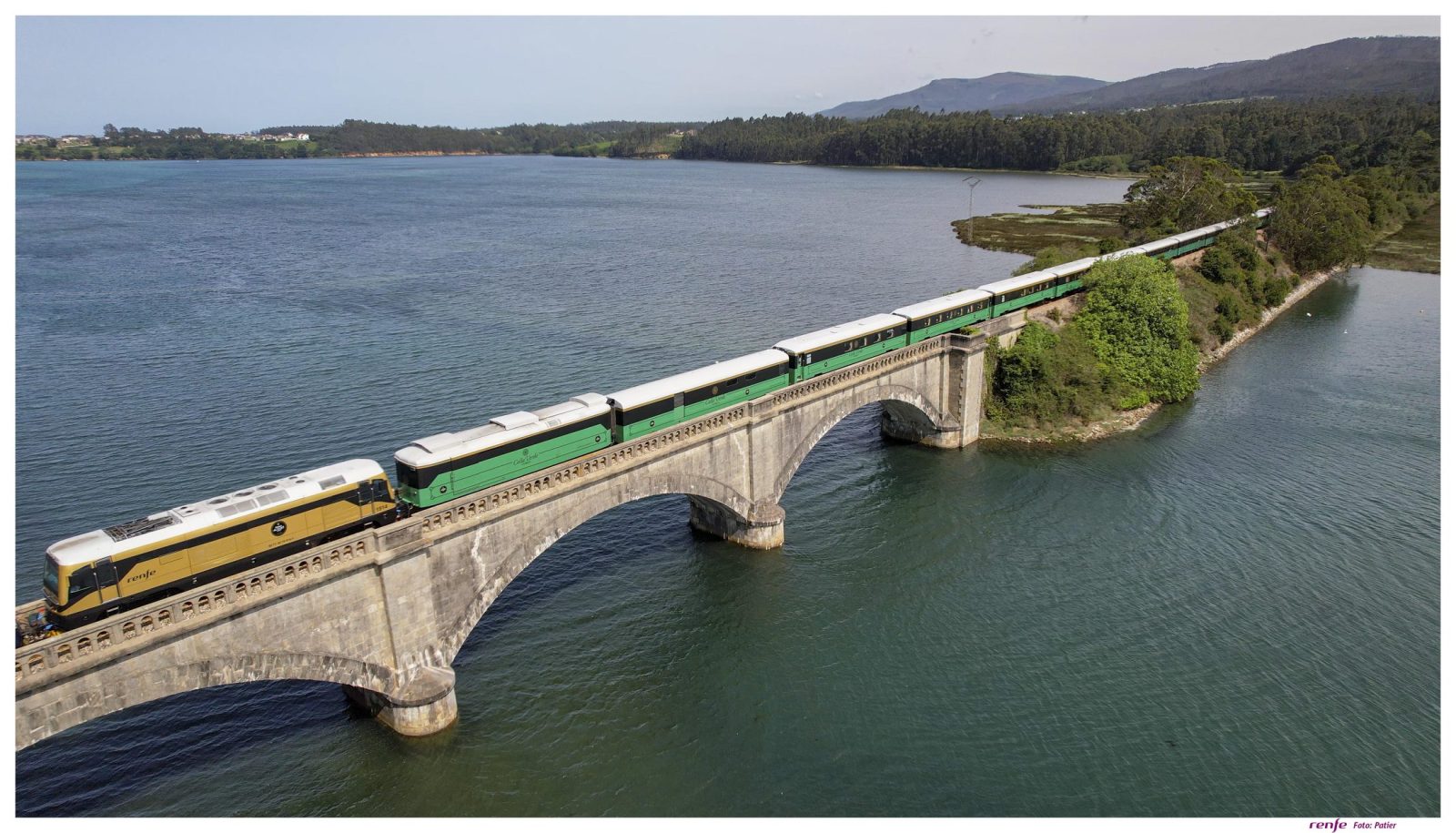
 Costa Verde Express
The Costa Verde Express glides between Bilbao and Santiago de Compostela through the verdant, less-visited north of Spain, combining 1920s Pullman heritage with gourmet dining, guided excursions, and private suite comfort.
 Spain · Europe
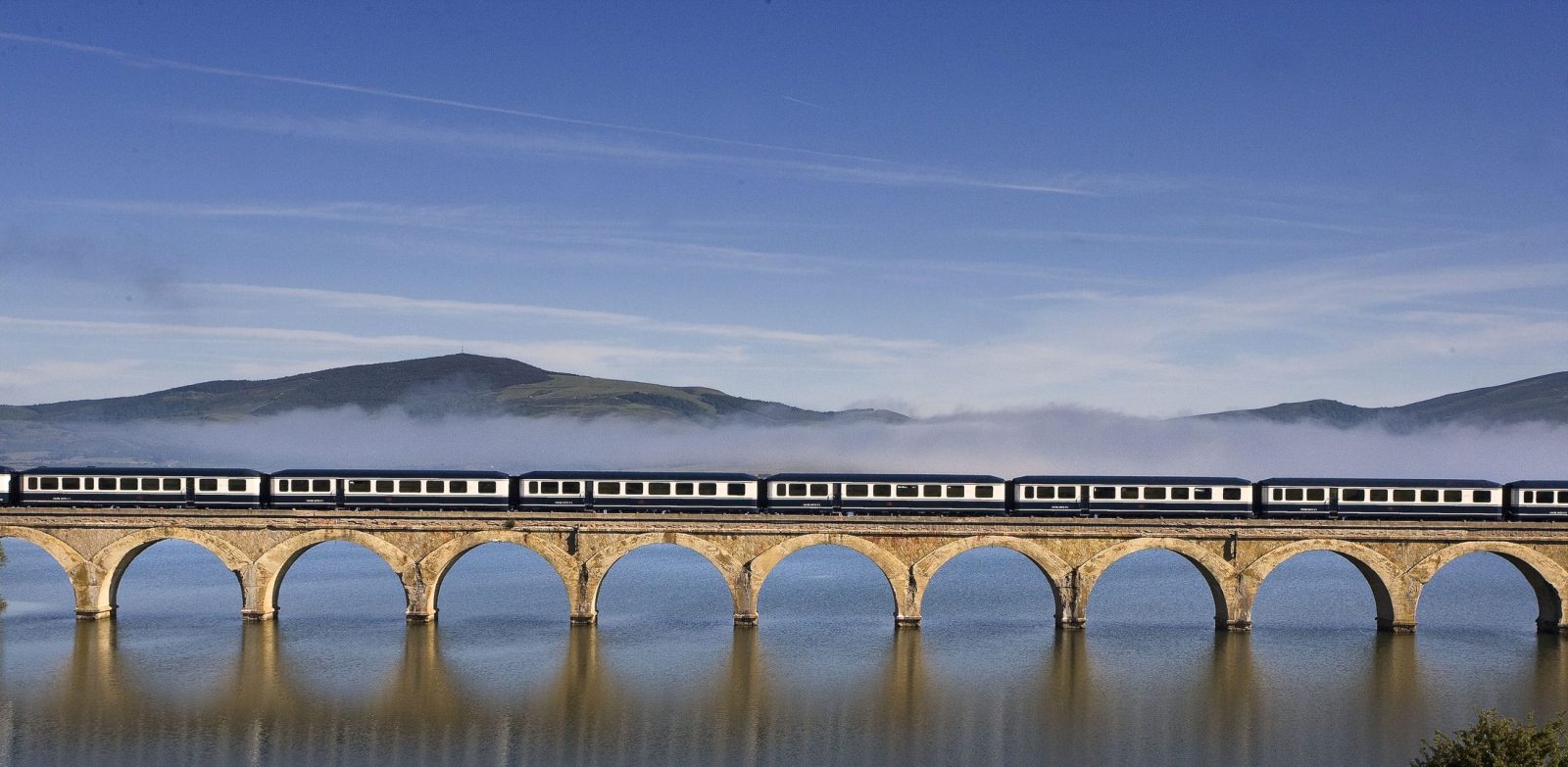
 El Transcantábrico Gran Lujo
El Transcantábrico Gran Lujo glides through the Atlantic-facing landscapes of Northern Spain, passing Basque cities, Asturian mountains and Galician pilgrimage routes aboard a lovingly restored five-star train hotel. Private suites with hydro-sauna bathrooms, heritage Pullman saloons and superlative regional cuisine make this one of Europe's most distinctive rail journeys.