
Venice needs no introduction, yet it never stops surprising: a city built on 118 islands, laced together by more than 400 bridges and threaded by the Grand Canal, where gondolas glide past Byzantine domes and Gothic palaces that have hardly changed in five centuries. There are no cars, no roads in the ordinary sense — only water, stone, and light — which is precisely why arriving here still feels like an event rather than a mere disembarkation.
For travellers who believe the journey should match the destination, Venice is one of the great set-pieces of luxury rail travel. The legendary Venice Simplon-Orient-Express glides into Santa Lucia station having crossed the Alps in vintage 1920s and 1930s carriages of polished marquetry and brass, delivering guests directly into the heart of the lagoon city in a manner no airport ever could. Orient Express La Dolce Vita, Italy's new generation of luxury rail celebrating the country's post-war glamour, likewise threads Venice into its network of grand Italian arrivals, while the Danube Express Golden Eagle brings guests south from Central Europe, crossing the Alps and the Veneto plain before delivering them to the water's edge.
Whether you step off the train and straight onto a private water taxi bound for St Mark's Square, or use Venice as the romantic bookend to a longer rail odyssey across Europe, the city rewards travellers who take their time — wandering beyond the crowds into quiet campi, sipping spritz at a canal-side bar, and watching the light change over the lagoon at dusk.
- ✦St Mark's Square and Basilica
- ✦Grand Canal by gondola or vaporetto
- ✦Doge's Palace and Bridge of Sighs
- ✦Rialto Market and cicchetti bars
- ✦Murano glass and Burano lace
- ✦World-class art at the Accademia and Guggenheim
- ✦Arrival aboard the Venice Simplon-Orient-Express
Places to See in Venice
St Mark's Square (Piazza San Marco)
Napoleon called it "the drawing room of Europe." Ringed by arcades, the square is the ceremonial heart of Venice, overlooked by the Campanile bell tower and the Torre dell'Orologio's astronomical clock.
St Mark's Basilica
A dazzling Byzantine cathedral sheathed in gold mosaics covering some 8,000 square metres, crowned by five domes and fronted by the four bronze Horses of Saint Mark.
Doge's Palace (Palazzo Ducale)
The Gothic seat of Venetian power for a thousand years, with opulent state rooms, the Golden Staircase, and the infamous Bridge of Sighs linking the palace to its former prisons.
Grand Canal
Venice's principal thoroughfare, best experienced by vaporetto or gondola, lined with more than 170 palazzi including the Ca' d'Oro and Ca' Rezzonico.
Rialto Bridge and Market
The oldest of the four bridges spanning the Grand Canal, its stone arch framing views over the busy Rialto fish and produce market that has traded here for centuries.
Gallerie dell'Accademia
The world's finest collection of Venetian painting, spanning Bellini, Titian, Tintoretto and Veronese, housed in a former convent by the Accademia Bridge.
Peggy Guggenheim Collection
A world-class trove of 20th-century art — Picasso, Pollock, Dalí, Ernst — displayed in the unfinished Palazzo Venier dei Leoni on the Grand Canal.
Murano and Burano Islands
A short boat ride into the lagoon reveals Murano's centuries-old glassblowing furnaces and Burano's rainbow-painted fishermen's cottages and lace-making tradition.
Teatro La Fenice
Venice's storied opera house, rebuilt after fire more than once, remains one of Italy's most important stages for opera and classical music.
Food & Gastronomy
Venetian cuisine is shaped by the lagoon and the old spice-trading routes of the Republic, favouring seafood, rice, and subtle sweet-and-sour notes rarely found elsewhere in Italy. No visit is complete without an evening of cicchetti — Venice's answer to tapas — hopping between backstreet bacari (wine bars) for small plates washed down with a glass of local wine.
- Sarde in saor — sardines marinated with onions, pine nuts, raisins and vinegar, a sweet-sour dish with roots in the galley provisions of Venetian sailors.
- Risotto al nero di seppia — risotto blackened and enriched with cuttlefish ink, a striking lagoon classic.
- Bigoli in salsa — thick wholewheat pasta tossed in a slow-cooked anchovy and onion sauce.
- Fegato alla veneziana — calf's liver sautéed with sweet onions, traditionally served with soft polenta.
- Baccalà mantecato — whipped salt cod blended with olive oil to a creamy spread, served on grilled polenta or crostini.
- Cicchetti — bite-sized bar snacks of baccalà, marinated vegetables, meatballs or seafood, best enjoyed with an Aperol or Select spritz.
- Tiramisù — the espresso-and-mascarpone dessert with contested but strong Veneto origins.
For provisions and atmosphere, the Rialto Market remains the city's beating culinary heart each morning, while a glass of prosecco or a classic Venetian spritz at a canal-side table is the ritual with which most evenings here begin.
Luxury Trains That Visit Venice
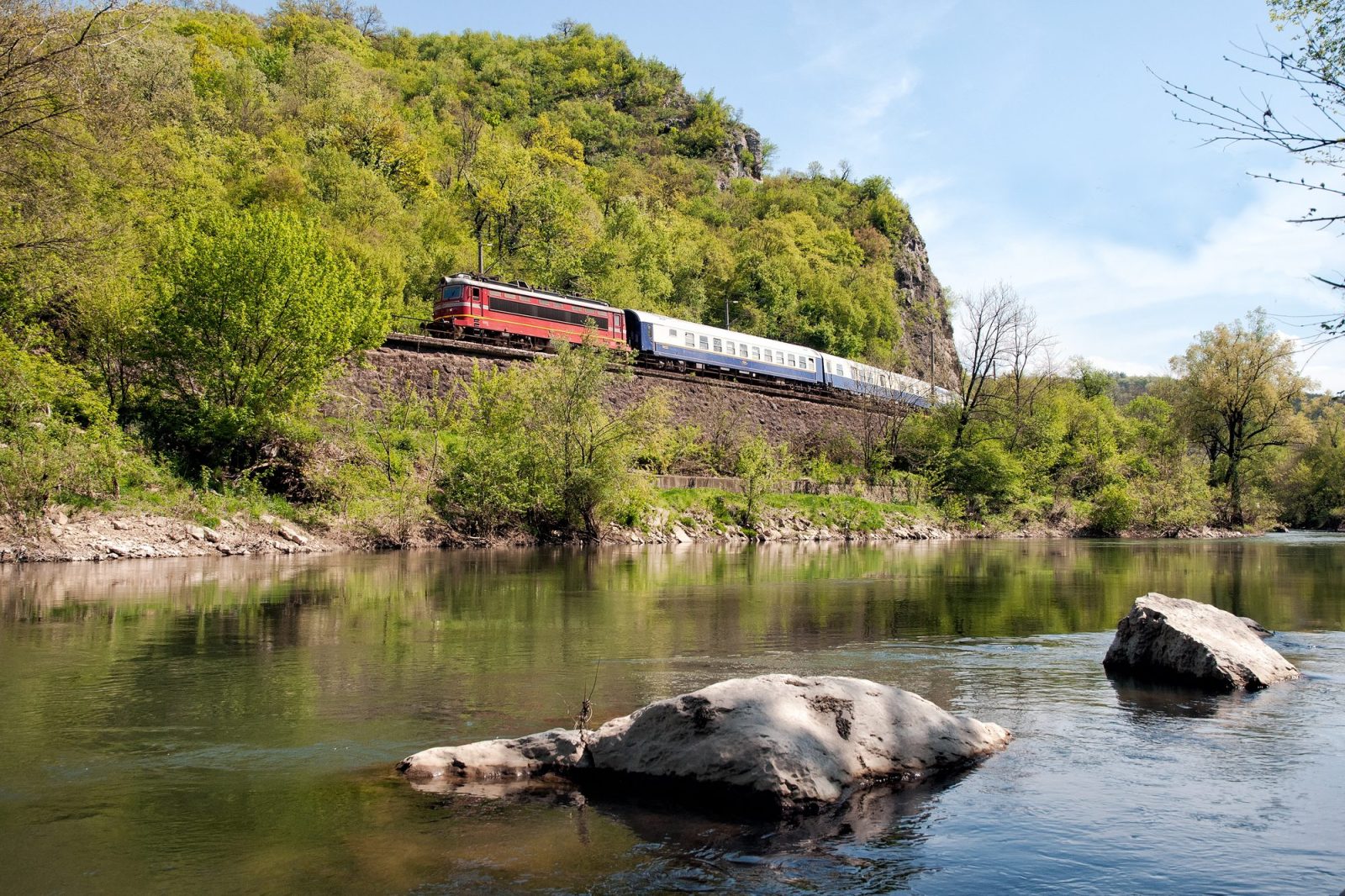 Europe · Central Europe · Eastern Europe · Balkans
 Danube Express Golden Eagle
The Danube Express carries just 50 passengers through the heart of Central and Eastern Europe, combining elegant cabin accommodation, freshly prepared regional cuisine, and expert-guided excursions into some of the continent's most storied cities and landscapes.
 Italy · Europe
 Orient Express La Dolce Vita
Orient Express La Dolce Vita revives the golden age of Italian travel, threading through 14 regions aboard 12 elegantly designed carriages. Leisurely-paced itineraries reveal UNESCO heritage sites, Tuscan vineyards, Sicilian coastlines and the secrets of Rome — all from the comfort of a boutique train for just 62 guests.
 France · Italy · Austria · Germany · Belgium · England · Hungary · Romania · Turkey · Europe
 Venice Simplon-Orient-Express
Step aboard the Venice Simplon-Orient-Express and enter a living legend — a lovingly restored Art Deco masterpiece gliding between Europe's greatest cities. From Paris to Venice, Budapest to Istanbul, each journey is a celebration of the golden age of rail travel.