When Italy's new luxury train was first shown to the press, at Rome Ostiense in June 2021, the carriages on the platform were not Italian, not new and not part of the train at all. They were French Pullmans delivered in 1929, borrowed for the occasion and hauled down the Tyrrhenian coast so that the project would have something glamorous to stand beside.
The train that eventually entered service in April 2025, the La Dolce Vita Orient Express, owes almost nothing to that Art Deco stock. It is built from the bodies of ordinary Italian Intercity coaches and dressed in the vocabulary of the 1960s. Understanding the difference between the two says a good deal about how luxury rail now invents its own past.
The borrowed Pullmans of June 2021
On 15 June 2021 the developer Arsenale presented what Italian railway journalists were then calling the Treno della Dolce Vita to officials and the press at Rome Ostiense. Guests were taken on a short run to Civitavecchia and back behind two preserved E.656 electric locomotives from Fondazione FS Italiane, the state railway's heritage foundation. At that stage the first passengers were expected in 2023.
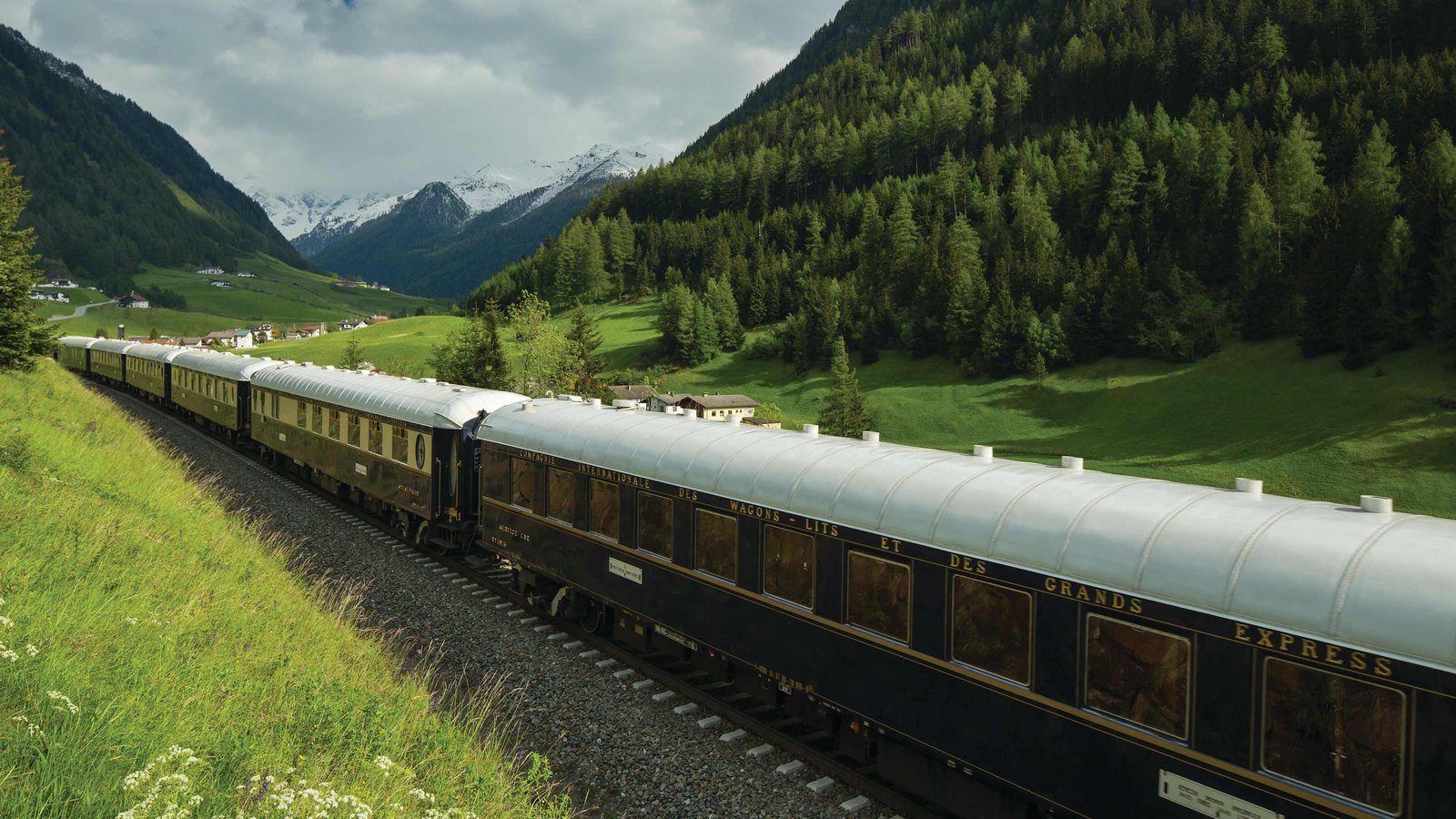
The carriages were the property of the French railways, which keep a small set of 1920s Compagnie Internationale des Wagons-Lits stock in working order for day excursions under the name Pullman Orient Express. They had been moved from Villeneuve-Saint-Georges, south of Paris, on 11 and 12 June, travelling along the Riviera and entering Italy at Ventimiglia. As the Italian rail magazine Ferrovie.it pointed out at the time, they are not the carriages of the Venice Simplon-Orient-Express, a separate train with a separate owner, though the two are easily confused.
What the Côte d'Azur cars actually were
The Pullmans belong to the Wagons-Lits type known as Côte d'Azur, after the Riviera service for which the company ordered them. According to Ferrovie.it's account of the class, all 34 were built by the Entreprises Industrielles Charentaises at Aytré, near La Rochelle, and delivered between 14 March and 30 October 1929.
- Nos. 4131 to 4147: seventeen cars with a kitchen and 20 seats.
- Nos. 4148 to 4164: seventeen cars without a kitchen and 28 seats.
- Interiors: depending on the car, glass panels by René Lalique or marquetry by René Prou, the subject of our piece on Lalique, Prou and the Wagons-Lits.
- Today: running on Minden-Deutz bogies and cleared for 160 km/h.
The set brought to Rome comprised Pullmans 4159 and 4161, the Pullman-bar 4160 (a conversion of one of the 28-seat cars), and three dining cars. Two of those, nos. 2976 and 2979, were built in Italy by Officine Reggiane in 1927; the third, no. 2869, came from Smethwick in England in 1925. They were among the first Wagons-Lits dining cars with steel bodies, and all three had at some point worked in Italy. These are the cars that fix the popular image of the Orient Express: royal blue with an ivory window band and gold lining, armchairs, table lamps, polished veneer. They are genuine Art Deco, and they are the context for Le Train Bleu and the making of the Côte d'Azur.
The Intercity coaches underneath
The train that carried paying guests is a different object. When the finished convoy was unveiled at Ostiense on 3 April 2025, Ferrovie.it described it as a careful revamp of former Trenitalia carriages of the Z1 type, the long-serving coaches that for decades formed the backbone of Italy's daytime Intercity services. The rebuilding was entrusted to two specialist firms in the south: CPL at Brindisi and Omer at Carini, outside Palermo. The same report called it the first luxury train designed and built entirely in Italy.
The sources do not agree on how big the train is. Arsenale's own project page gives twelve cars per train. Ferrovie.it, reporting from the platform at the launch, counted six carriages in the first convoy, four with beds, one restaurant and one bar, plus a UIC-X service car. Both agree on the accommodation: 31 cabins per train, made up of 18 suites, 12 deluxe cabins and a single La Dolce Vita Suite. The likeliest reading is that the totals depend on how sleeping, dining, service and crew cars are counted, but neither source spells that out, and it is worth treating any precise carriage figure with caution.
Why the 1960s and not the 1920s
Arsenale describes the concept as a tribute to la dolce vita, the period of glamour and artistic ferment in Italy in the 1960s, and the name itself comes from Federico Fellini's film of 1960. That choice is the real design story. An Italian train dressed as a 1929 Wagons-Lits Pullman would have been a copy of something French, Belgian in origin and already well represented elsewhere; the history of that company is told in our article on Nagelmackers and the European sleeping car. The economic miracle years offered Italy a style that was unmistakably its own.
The interiors are by Dimorestudio, the Milan practice of Emiliano Salci and Britt Moran. According to the launch coverage, the studio set out to reinterpret Italian railway style with explicit nods to Gio Ponti, Nanda Vigo, Gae Aulenti and Osvaldo Borsani: architects and designers associated with mirrored surfaces, lacquer, sculpted furniture and strong colour rather than with the geometric inlay of the Deco cars. The Orient Express name is there for recognition. The look is Milan, not Paris.
Where the Art Deco survives
The Deco revival of the title is real, but it sits mostly at the edges. The Orient Express lounge at Ostiense, designed by the artist and architect Hugo Toro, is described by Arsenale as combining 1960s Italian glamour with mandarin lacquered ceilings, Art Deco details and neon inspired by vintage train interiors. In other words the station is allowed to look back to the interwar years; the train looks to the decade when Italians last travelled with real swagger.
That division is a useful corrective to a common assumption, which is that every train carrying the Orient Express name must be a restored interwar set. Our guide to the Orient Express trains compared sets out which carriages are original and which are reinterpretations. La Dolce Vita is firmly the second kind, and openly so.
A short chronology
- 1925 to 1929: the dining and Côte d'Azur Pullman cars later shown in Rome are built in England, Italy and France.
- 1960: Fellini's La Dolce Vita gives the period, and eventually the train, its name.
- 15 June 2021: the project is presented at Rome Ostiense using borrowed French Pullmans.
- 3 April 2025: the finished train, rebuilt from Z1 coaches, is unveiled at Ostiense.
- 4 April 2025: first passengers depart on a journey to the vineyards of Montalcino.
Travelling on it, and on its older relations
The La Dolce Vita Orient Express runs from Rome Ostiense on short journeys of one to a few nights, with menus devised by the chef Heinz Beck. Its itineraries have been built around places that suit the train's slow pace: Venice, Portofino, Siena and the Tuscan vineyards, the Sassi of Matera, and Sicily as far as Taormina.
Anyone who wants the 1920s original rather than the 1960s homage should look to the Venice Simplon-Orient-Express or its British day-train counterpart, the British Pullman. Taken together they make a neat pair: one preserves the Art Deco carriage, the other borrows its name and replaces its look with something Italy was entitled to call its own. More of these stories are collected in the Palace Trains journal.