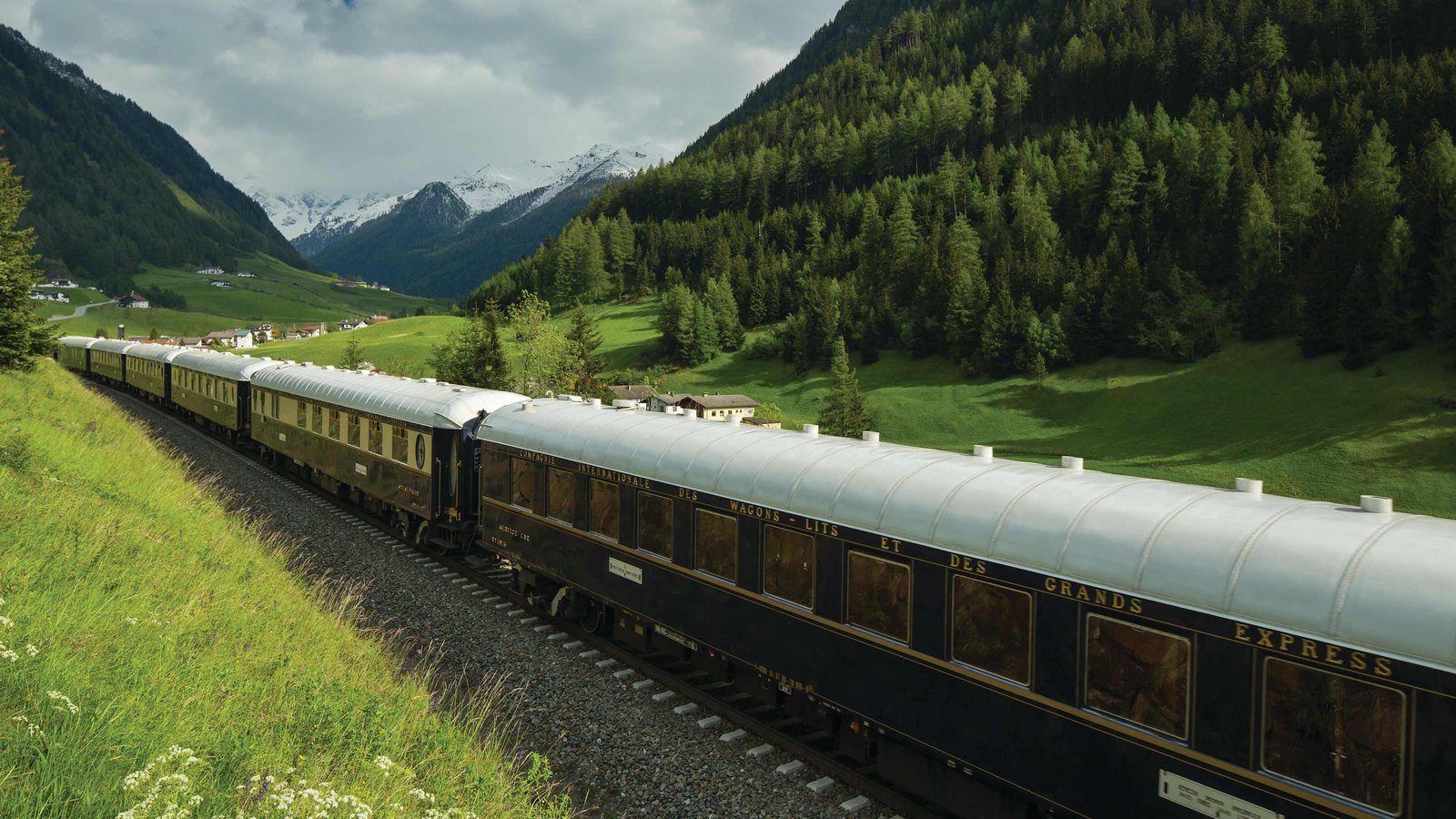
The Orient Express did not run all the way to Istanbul in 1883, despite the date printed on a good many souvenir posters. Passengers on the early service left the train at the Danube, crossed by ferry, boarded a second train in Bulgaria and finished the journey to the Bosphorus by sea. The through carriage that finally rolled into the Ottoman capital by rail did so in 1889, and the grand terminal at Sirkeci opened only in November 1890.
That building, on the tip of the old peninsula beside the Golden Horn, is the real end of the line, and its history is shorter, stranger and more instructive than the legend that grew around it. It explains how a railway concession, a Prussian architect and a Belgian sleeping-car company produced the most famous terminus in the East.
A railway that took thirty years to arrive
After the Crimean War the Ottoman authorities concluded that Istanbul needed a rail link with Europe. The first contract, signed in January 1857 with a British member of parliament named Labro, was cancelled within three months because he could not raise the capital. Further contracts with British and Belgian entrepreneurs in 1860 and 1868 failed in the same way.
The concession that held was awarded on 17 April 1869 to Baron Maurice de Hirsch, a Bavarian-born banker working from Belgium, for what became the Rumeli Railroad. Work on the first fifteen kilometres from Istanbul to Halkalı began on 4 June 1870 and finished on 4 January 1871. The line was then pushed on to Sirkeci, because Yeşilköy was too far from the business district of Eminönü. The extension opened on 21 July 1872, running along the Marmara shore beneath the walls of the Topkapı Palace gardens, a route the Sultan Abdülaziz himself is recorded as having decided.
The temporary station that lasted seventeen years
In 1873 a station described as temporary was built at Sirkeci. It served until the permanent building replaced it, which is to say for the best part of two decades. The permanent terminal was begun on 11 February 1888 and opened on 3 November 1890. Its first name was Müşir Ahmet Paşa Station, and the name Sirkeci was the neighbourhood's, not the building's.
- 1857-1868: three early concessions fail for lack of capital.
- 17 April 1869: the Rumeli Railroad concession goes to Baron de Hirsch.
- 21 July 1872: the line reaches Sirkeci.
- 1 June 1889: the first direct train from Paris reaches Constantinople.
- 3 November 1890: the permanent terminal opens.
The myth of the 1883 arrival
Many popular accounts, and some reference works, state that the first Orient Express left Paris on 4 October 1883 and ended its run at Sirkeci. The fuller record is less tidy. The first Express d'Orient left the Gare de l'Est on 5 June 1883 for Vienna. From 4 October 1883 it ran on to Giurgiu in Romania, where passengers were ferried across the Danube to Ruse in Bulgaria, took another train to Varna and completed the journey to the city by ferry. Sources disagree on the dates and on how much of the trip was by rail, which is itself telling. The first direct train to Constantinople left Paris on 1 June 1889, and the name Orient Express was formally adopted in 1891. The dining car and the sleeping berths were the work of Georges Nagelmackers; for the company behind them, see the story of the European sleeping car.
A Prussian architect and a deliberately Eastern building
The architect was August Jasmund, a Prussian sent to Istanbul by the German government to study Ottoman architecture, who also taught architectural design at the School of Polytechnics, today Istanbul Technical University. His name is spelled Jachmund in some sources. The result is regarded as one of the best-known examples of European Orientalism: a European railway shed and station dressed in Ottoman and Islamic motifs, standing on about 1,200 square metres.
It was also a modern building for its day, with gas lighting and winter heating from large tile stoves made in Austria. The terminal restaurant, now called Orient Express, became in the 1950s and 1960s a gathering place for journalists, writers and other figures from the press. The Bilkent University repository dates the restaurant to the station's opening in 1890.
Where the train met the water
Sirkeci sat on the European shore, while the Asian lines of the Ottoman Railways ended at Haydarpaşa across the Bosphorus. Ferries from piers beside the terminal carried passengers between the two, so the great express never crossed the strait by rail. The traveller who arrived by sleeping car stepped onto a quay, not into a connection. This is why the station feels like a ship's landing as much as a railway terminus, and why the neighbouring district of Eminönü still functions as a ferry hub.
For the route that carried the through traffic after 1919, see the Simplon tunnel and the Orient Express route. The Simplon Orient Express ran via Milan, Venice and Trieste, and soon became the most important rail route between Paris and Istanbul. Anyone interested in the cast of characters it attracted may enjoy the tale of Mata Hari and the Orient Express.
Withdrawal, silence and a second life
The direct Orient Express stopped serving Istanbul on 19 May 1977. It was cut back repeatedly: to Bucharest, then Budapest in 1991, then Vienna in 2001, and after a final departure from Paris on 8 June 2007 it began at Strasbourg. It ceased to operate entirely on 14 December 2009. Regional and international trains continued to use Sirkeci for decades afterwards, including the Friendship Express to Thessaloniki between 2005 and 2011 and the Bosphorus Express to Bucharest.
Services to the terminal were suspended on 19 March 2013 so the existing line could be rebuilt for the Marmaray commuter railway. An underground Sirkeci station opened on 29 October 2013 on the new trans-Bosphorus tunnel, which at last joined the European and Asian networks that the old ferries had separated. The surface terminal reopened on 26 February 2024 as part of the T6 tramway and U3 rail line. The Istanbul Railway Museum, which opened in September 2005, occupies part of the building, and the station is preserved largely in its original state. Visitors to Istanbul can see all of this within a short walk of the Golden Horn.
Travelling the route today
The scheduled train is gone, but the experience survives in private form. The Venice Simplon-Orient-Express runs restored 1920s and 1930s carriages, and its operator has described its programme as including the original Paris to Istanbul route; see the train page for the itineraries currently described. For a comparison of the several trains that carry the name or its spirit, read the Orient Express trains compared. Travellers who prefer the Italian end of the story may like arriving at Venice Santa Lucia, and those still choosing a first journey can browse all the trains or the journal for more.