The station that receives every train in Venice is named after a church that no longer exists. Santa Lucia, parish church since the twelfth century, was demolished in 1861 to make room for the terminus, and the saint's body was carried off to San Geremia.
What replaced it is a low, wide building that, unusually for a terminus, does not stand between the traveller and the city but opens straight onto the Grand Canal. Arriving here is the closing scene of one of the few European rail journeys that still ends exactly where it should.
A church traded for a terminus
According to Jacopo Sansovino, the church of Santa Lucia was founded in 1192 as a parish dedicated to the Annunciation. Tradition holds that it took its present name in 1279, after pilgrims drowned on their way to venerate the body of St Lucy, brought to Venice after the Fourth Crusade and kept on San Giorgio Maggiore. The relics were moved to the church on the main island. In 1580, shortly before his death, Andrea Palladio is said to have drawn up a renovation of the interior, although the attribution is disputed, since the work was finished some thirty years later.
In 1806, after the Napoleonic invasion, the nuns who held the church and convent were expelled. Then came the railway. Construction of the station began in 1860 under Austrian rule, and in 1861 the convent and church were demolished for the station building and its forecourt. The station inherited the name. The only visible trace of the church is a carved stone set in the pavement.
The causeway that made it possible
A terminus in the lagoon needs a way across the water. The railway viaduct linking Venice to the mainland dates from 1846, so trains reached the city some years before the first Santa Lucia station was built. Until 1933 a visitor could reach the historic centre only by boat or by rail, which is why the station mattered so much more than a typical city terminus.
The road bridge came later. Designed by engineer Eugenio Miozzi and opened in 1933 as the Ponte Littorio, it was renamed Ponte della Libertà after the Second World War. It runs 3.85 kilometres alongside the older railway viaduct, which is still in use. Many accounts blur the two; the rail line came first by almost nine decades.
The modernist building nobody expects
Visitors imagining a nineteenth-century iron shed will be surprised. The present building is one of the few modernist structures facing the Grand Canal. Its origins lie in a series of plans begun by the rationalist architect Angiolo Mazzoni in 1924. In 1934 a competition for the detailed design was won by Virgilio Vallot, and between 1936 and 1943 Mazzoni and Vallot collaborated on the building, with Mazzoni designing the train hall.
Wartime stopped the work. English-language sources state that the station was completed in 1952 on a design developed by another architect, Paul Perilli, while some other sources give 1954 for completion. The sources disagree, and we have not been able to settle the point from them alone. What is not in dispute is the result: a building that is low and wide, flanked by Venetian lions, and deliberately restrained so that it does not dominate the canal it faces.
Milestones
- 1846: the railway viaduct across the lagoon is built.
- 1860: construction of the station begins under Austrian rule.
- 1861: the church of Santa Lucia and its convent are demolished.
- 1933: the road bridge and Piazzale Roma open.
- 1934: Vallot wins the competition for the present building.
- 1952: the station is completed, by the most commonly cited date.
- 1994: the old goods yard is converted, raising the platform count from 15 to 23.
Stepping out onto the water
The station sits in Cannaregio, near the western end of the Grand Canal. The concourse in front of it looks across the water, and the Ponte degli Scalzi links it to the sestiere of Santa Croce. There is no square to cross and no taxi rank to queue at: the first sight of Venice is the city itself, and the first vehicle is a boat. For travellers who have spent a day or two on a long-distance train, few terminals offer a more abrupt change of scale, from the long straight of the Veneto plain to a place with no road traffic at all. See our guide to Venice for what lies beyond the steps.
An arrival the Orient Express made famous
Venice has been a destination of the great European sleeping-car routes since the days when Georges Nagelmackers's sleeping cars crossed the continent. The Alpine approach is told in our account of the Simplon tunnel and the Orient Express route, and the comparison of the different trains that carry the name is in Orient Express trains compared. The tunnels that carry the route through the mountains are a story of their own, including the Arlberg engineering on the Austrian side.
Arriving by train today
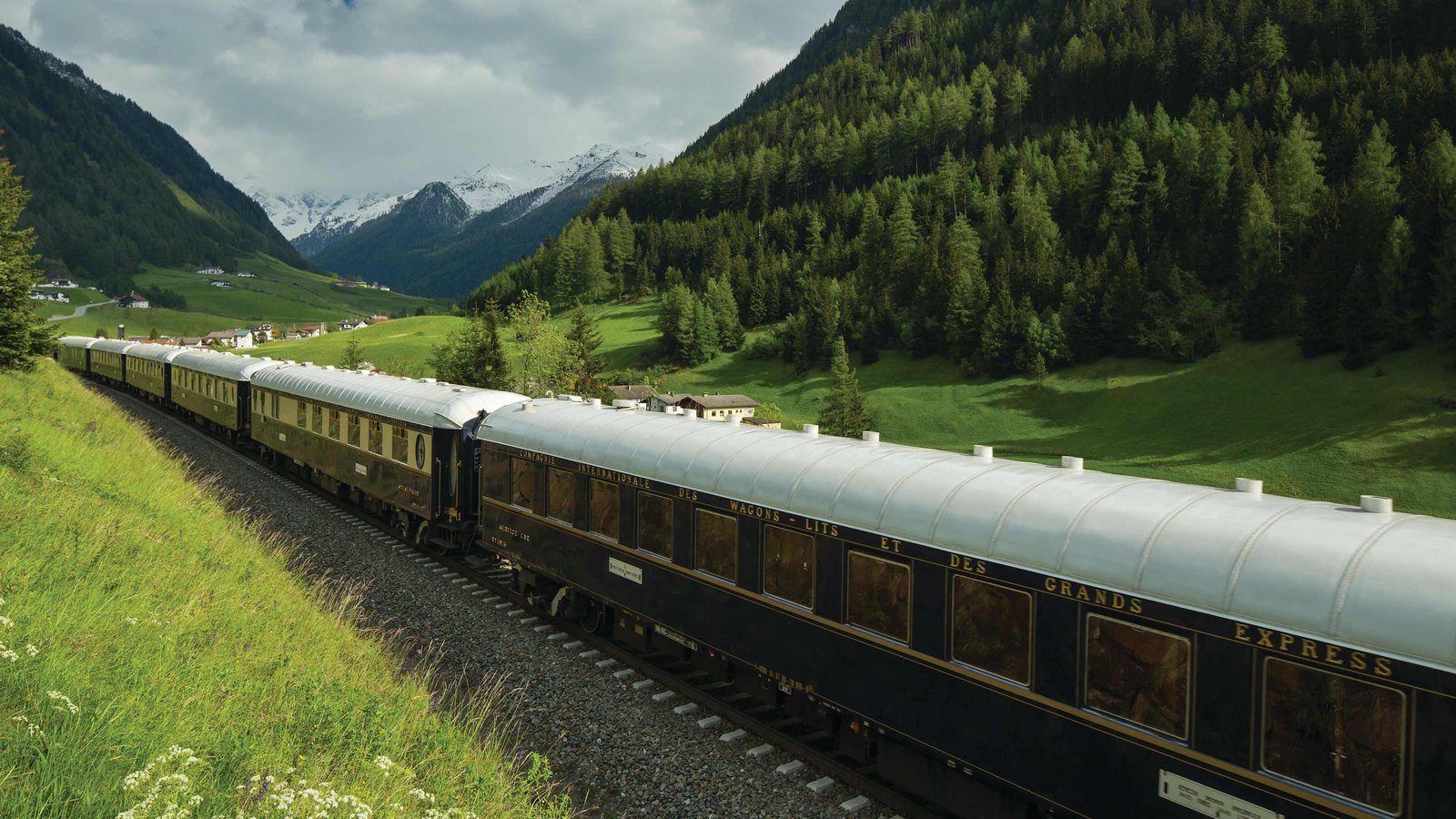
The modern revival is the Venice Simplon-Orient-Express. Its founder, James Sherwood, bought two original carriages at auction in 1977 and went on to spend US$16 million acquiring 35 sleeper, restaurant and Pullman cars; the first London to Venice run took place on 25 May 1982. Its restored carriages are mostly from the 1920s and 1930s, a fit for a station whose present form was drawn up in those same decades. A related experience is Orient Express La Dolce Vita, which draws on the same Art Deco tradition, as described in our account of its revival.
Whatever the train, the final approach is the same: the viaduct across the lagoon, the slow turn into the terminus, then the steps and the water. Browse every luxury train we feature, or read more in the Journal.