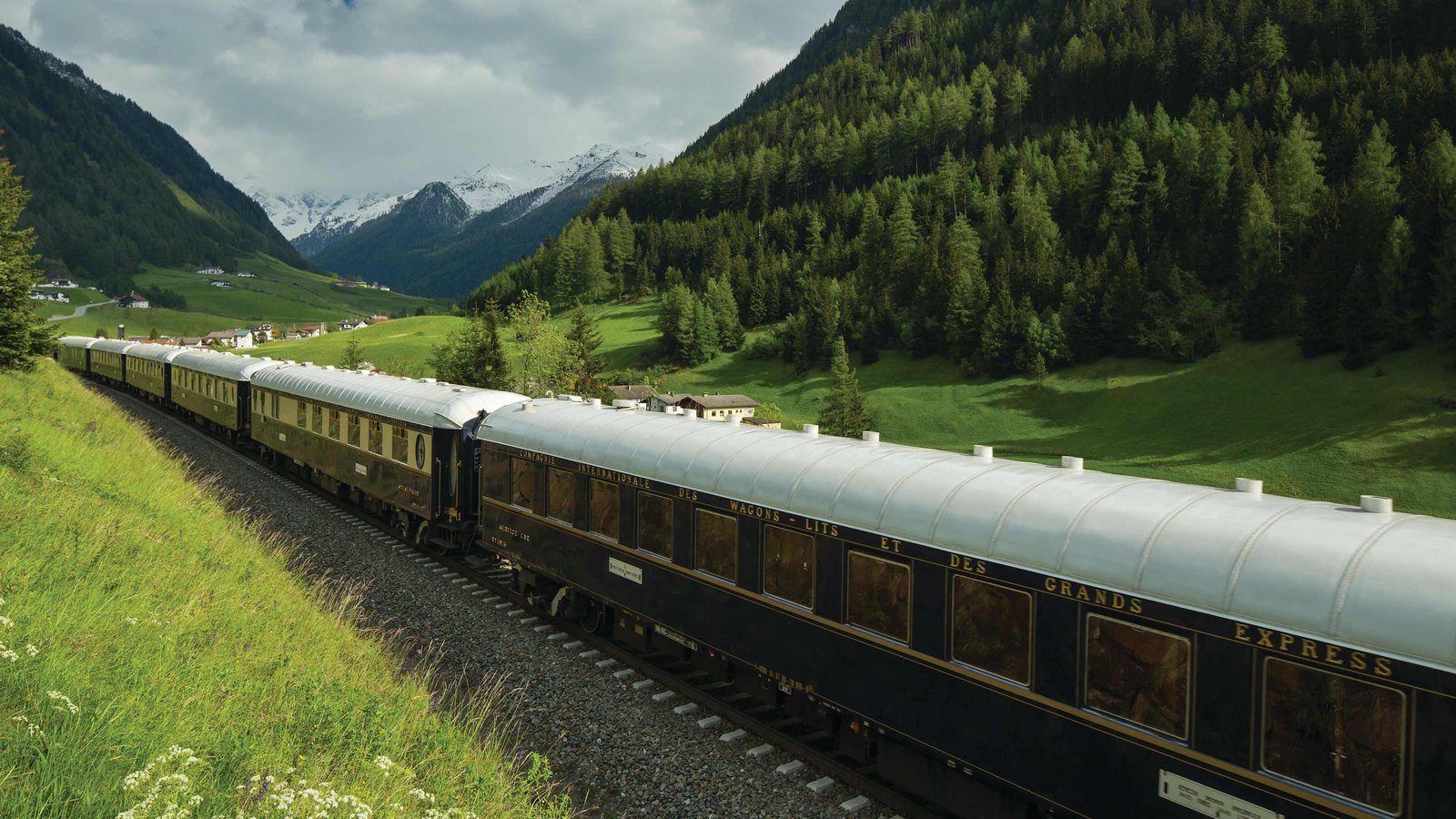
Sleeping car 3555, built near La Rochelle in 1929, spent the Second World War as a hotel in Lyon. Car 3544 was stored at Limoges, where, according to the carriage histories published by Belmond, it was used as a brothel. Both now belong to the Venice Simplon-Orient-Express.
War did not simply interrupt the Orient Express. It requisitioned the cars, redrew the route, produced rival trains in the name of one side or the other, and turned a Wagons-Lits dining car into the most politically charged railway vehicle in Europe.
1914: a train without a continent
The Orient Express was the creation of the Compagnie Internationale des Wagons-Lits, the firm through which the Belgian Georges Nagelmackers brought the sleeping car to Europe's expresses. It owned and staffed the carriages but no locomotives, relying on one state railway after another to haul them from Paris towards Constantinople. The arrangement assumed that the states along the way were on speaking terms.
In July 1914 they ceased to be, and the train was suspended. Wagons-Lits coaches were confiscated for military use, and in Germany and Austria-Hungary a new company, Mitropa (short for Mitteleuropa), was formed to take over the property and services of what was now an enemy-owned business. Accounts give different dates in 1916 and 1917 for its formal start, but its purpose is not in doubt.
The Balkanzug and the Kaiser's shop window
Germany's answer to the missing express was the Balkanzug, which linked Berlin and Munich with Constantinople once the line through Serbia and Bulgaria was in friendly hands. One railway history dates the first departure from Munich to 15 January 1916, with a sleeper and a diner requisitioned from Wagons-Lits and further sections joining along the way. Another gives 1 January for the Berlin service, running twice a week on a schedule of 58 hours.
It was as much an argument as a train. J. M. de Beaufort, an Allied journalist or spy depending on the telling, called it the "show train" of the world. The ambition was a German train to Baghdad and a permanent replacement for the Orient Express. It lasted until October 1918. The Orient Express itself was absent for the duration, which causes difficulties for one of its best-known legends, that of Mata Hari and the Orient Express.
Dining car 2419 D
The most famous Wagons-Lits carriage of the First World War was a place to eat. Restaurant car 2419 D entered service in June 1914. In the autumn of 1918 the French army requisitioned it, had it refitted at Saint-Denis as an office, and attached it to the headquarters train of Marshal Ferdinand Foch. In a siding near Rethondes, in the forest of Compiègne, German delegates signed the armistice on 11 November 1918.
It is tempting to call it an Orient Express carriage. The museum accounts consulted here establish only that it belonged to the company that ran the Orient Express, which is a different claim. After a brief return to dining duty it was given to the French state in 1919, stood in the courtyard of Les Invalides from 1921 to 1927, and was then restored, with money from an American, Arthur Henry Fleming, and housed in a purpose-built shelter in the clearing.
In June 1940 Hitler had it brought out and placed on the 1918 spot, and France signed its own armistice inside on 22 June. The car was taken to Berlin as a trophy and moved to Thuringia in 1944. How it ended is disputed. The Musée de l'Armée says it was destroyed in April 1945 on Hitler's orders; another account credits the SS with fire or dynamite in March; the French defence institute IHEDN reports an accidental fire at the station where it stood unguarded. The popular version, a deliberate demolition, is therefore possible but not settled. The carriage shown at Compiègne today is 2439 D, from the same series, installed in 1950 and fitted out to match.
1919: a route drawn to avoid Germany
Peace brought the train back along new lines. From February 1919 the Orient Express ran through Zurich and over the Arlberg into Austria, keeping clear of German territory. On 11 April the Simplon Orient Express began running from Paris through Lausanne and the Simplon Tunnel to Milan, Venice, Trieste and Belgrade, reaching Constantinople from 1920. According to the rail historian Mark Smith of Seat61, the Treaty of Versailles contained a clause obliging Austria to accept it, since the country had previously insisted that international trains crossing its territory run via Vienna. A route chosen for political reasons became the classic way east.
1939 to 1945: grey trains and mine wagons
The great expresses stopped in September 1939, although an Orient Express between Munich and Bucharest and a truncated Simplon service east of Lausanne reappeared briefly in 1940. The same year King Carol of Romania left his country by train with his mistress, an escape that Belmond associates with sleeping car 3425.
What continued through the Balkans was a military operation wearing timetable clothes. From 1941 a Berlin branch ran on to Sofia, with Mitropa sleepers, including from 1942 a through car from Paris. Wagons-Lits sleepers from Rome and Turin were attached at Belgrade until Mussolini's fall in 1943. Partisans repeatedly attacked the line. A frequent passenger, an SS courier, later told one railway historian that in Serbia as many as seven wagons were pushed ahead of the locomotive to absorb landmines, with a gun wagon attached. Mitropa's sleepers on the route were withdrawn in September 1944.
Where the carriages hid
Many of the vintage cars that would later be gathered under the Orient Express name were then working other services, notably Le Train Bleu to the Riviera. Their wartime records, as Belmond tells them, are strikingly domestic:
- 3483 was stored at Pouancé at the start of the war.
- 3525 sat out the whole conflict at Lourdes.
- 3539 was stored in Paris, then used by the US Army Transportation Corps from 1945 to 1947.
- 3544 became a brothel at Limoges, and in 1946 was elevated to the Royal Dutch Train.
- 3552 was garaged at Lourdes at the outbreak and ended up as a hotel in Lyon, where 3555 also served as one.
- 3674, a bar car, worked domestic services in occupied France.
The road back, and what survives
The Simplon Orient Express resumed in November 1945, three times a week towards Sofia, and reached Istanbul again in 1947. The through cars to Athens had to wait until 1951 for the Greek and Yugoslav border to reopen. Soldiers were ahead of civilians: from July 1945 British military trains known as Medloc used the Simplon route between Milan and Calais, originally to carry troops home.
- July 1914: the Orient Express is suspended.
- January 1916: the Balkanzug begins.
- 11 November 1918: the armistice agreed in car 2419 D takes effect.
- April 1919: the Simplon Orient Express starts.
- 22 June 1940: the second armistice is signed in the same car.
- November 1945: the Simplon service returns.
The wartime survivors are not merely museum pieces. In 1977 the American businessman James Sherwood bought two original carriages at auction in Monte Carlo, tracked down others and had them restored, work of the kind still done in heritage carriage workshops. The train was relaunched in 1982. A traveller on the Venice Simplon-Orient-Express can read each car's history on the panel at its end, and anyone puzzled by the various trains that have shared the name can start with this comparison of the Orient Express trains.